
Retiring abroad
Exit tax: what it really costs to leave Norway with your investments
The first time I saw the words exit tax, I filed them under problems for people with yachts. Then I ran the sum on my own index funds and realised the rule was pointing straight at me. If you have spent years quietly building a pot in Norway, and you ever think about leaving, this is the one that can follow you out the door. Here is what it is, who it actually hits, and how to see it coming before it lands on your plan.
 What an exit tax actually is
It is a departure tax. The day you stop being a tax resident, the country looks at the unrealised gains in your investments, the growth you have on paper but have never sold, and treats it as though you sold the lot on your way out. You did not sell. You may not have the cash. The gain gets assessed anyway. The logic, from the tax office's side, is that you built that growth while you lived there, so you should not be able to skip the country to escape the bill on it.
 Why it hits FIRE people hardest
Two reasons, and they compound. Financial independence is built on years of quiet compounding, so by the time you are ready to stop working, your pot can carry a large latent gain. Latent gain is exactly what an exit tax measures. Then there is the second half: retiring early often means moving somewhere your money stretches further, which is the trigger. The people most likely to pack up are the people carrying the most unrealised gain. It is almost designed to find you.
The people most likely to pack up are the people carrying the most unrealised gain.
 How Norway's version works (utflyttingsskatt)
Norway tightened these rules in recent years, and the old escape hatch, leave, sit still, and watch the charge quietly lapse, is largely gone. In broad strokes today: gains above a threshold are assessed when you emigrate, you generally have ways to pay over time rather than all at once, and the liability can stick with you for years, reaching even to gifts you make abroad or to your estate on death. The exact threshold, the payment window, and whether interest applies all live in the current rules, which move, so read this as the shape of the thing and check skatteetaten.no for the numbers that apply to you.
| The question | The short answer |
|---|---|
| What gets taxed? | Unrealised gains in your investments above a threshold |
| When is it assessed? | When you emigrate and stop being a tax resident |
| Can you wait it out? | Not anymore, that escape hatch was largely closed |
| How do you pay? | Often over time, not all at once |
| Can it reach gifts or death? | Yes, the liability can follow you for years |
Broad strokes only; the thresholds and windows move, so confirm current rules at skatteetaten.no.
 What it does to your plan
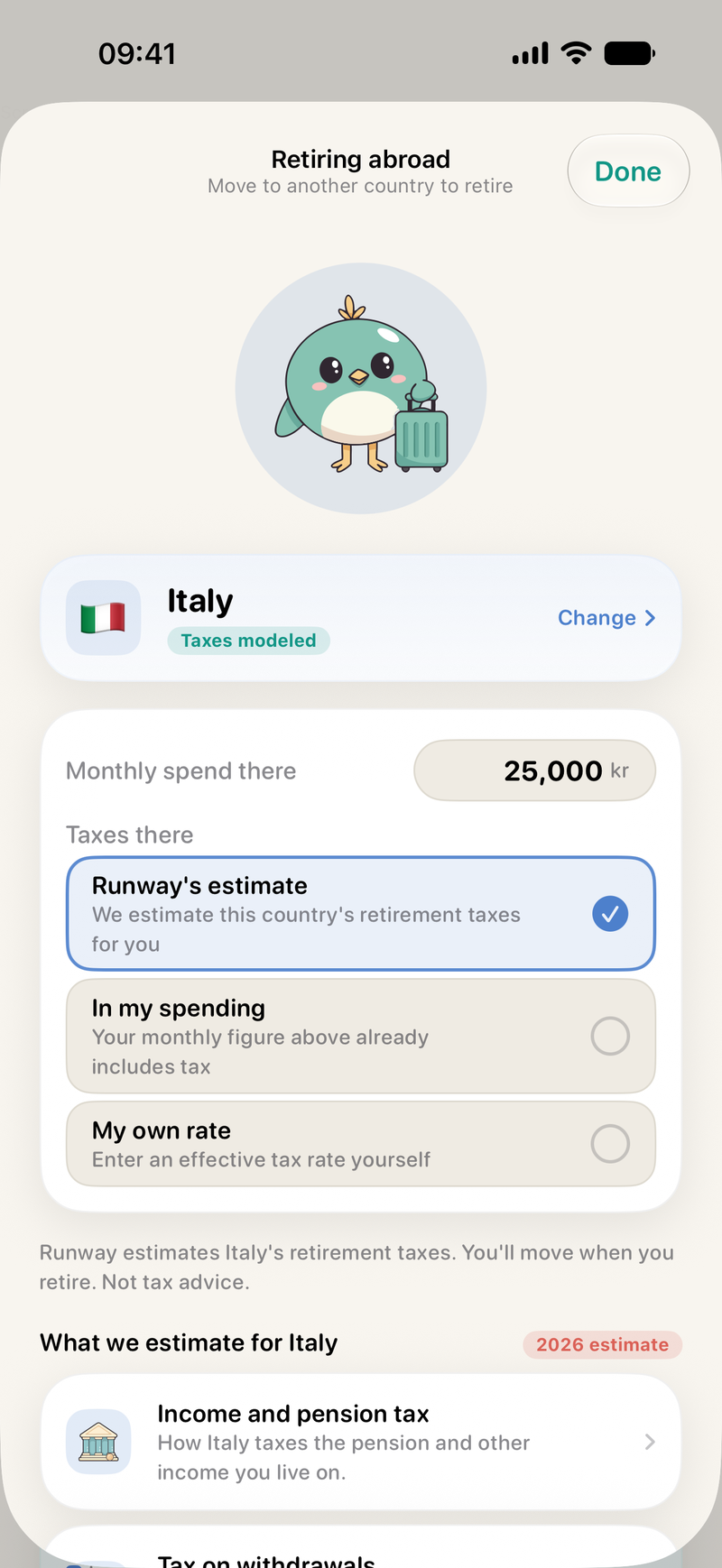
It is usually a one-off cost, but it can be a big one, and it lands at the worst moment: right as you are trying to downshift and live off the pot. A plan that says "moving to Portugal saves me a fortune" and quietly ignores the exit bill is too rosy. The honest move is to price it as part of the move, not a footnote you discover later. I went deeper on the whole cross-border picture in which FIRE calculators handle a move abroad, and on the Norwegian side of things in the FIRE number in Norway.
 Norway is not the only one
Exit and departure taxes are not a Norwegian quirk. Versions of the idea show up across a number of countries, in different shapes and with different triggers. What matters for your plan is not whether your country has "an exit tax" in the abstract, but which of three shapes it takes.
| Leaving | What the rule does on the way out | Does it bite an ordinary FIRE portfolio? |
|---|---|---|
| Norway | Utflyttingsskatt deems your shares and funds sold. A NOK 3 million net-gain deduction, then the 37.84 percent share rate. Interest-free instalments over 12 years, or defer as a lump sum with interest. Waived or refunded if you move back within 12 years still holding the shares. | Yes. This is the one written for people like you |
| Germany | InvStG paragraph 19(3), extended by the JStG 2024 from 1 January 2025, deems a disposal of private fund units, charged at the Abgeltungsteuer net of the Teilfreistellung. | Only if concentrated: units whose acquisition cost reaches EUR 500,000, or a holding of 1 percent or more of a single fund in the last five years |
| France | Article 167 bis CGI, aimed at substantial company stakes rather than portfolios. | Rarely. It targets stakes of 50 percent or more, or holdings above EUR 800,000 in one company |
| Canada | Section 128.1(4) deems a disposition when you cease residency, at the same 50 percent inclusion your ordinary drawdown pays. RRSPs, RRIFs, TFSAs and Canadian real property are excluded. | It moves the timing, not the rate |
| Australia | Ceasing residency deems a CGT event, with the same 50 percent discount the drawdown gets. Super and Australian real property are excluded, and you can elect under section 104-165 to disregard it. | Same shape as Canada, and electable |
| United States | Section 877A hits covered expatriates, meaning people renouncing citizenship or handing back a green card, not people retiring abroad. | No, but citizenship-based taxation keeps you filing on worldwide income wherever you move |
Read down that last column and the three shapes separate cleanly. Norway, and Germany in its narrow concentrated case, charge a genuine extra bill: money you would not have paid had you stayed. Canada and Australia accelerate a tax you were going to pay anyway, at the rate you were going to pay it, which changes when you need the cash but not how much the retirement costs. France and the United States mostly do not aim at you at all, though an American carries a filing obligation across every border for as long as they hold the passport.
That difference is why Runway prices Norway's exit tax and Germany's into a plan, and does not invent one for Canada or Australia. Charging a border bill on top of the drawdown's own realisation tax would count the same money twice. Those two are raised as a question during onboarding instead, because the honest answer depends on facts a projection cannot see.
The practical rule holds wherever you start: assume the question exists, and check it before you commit to a date. It is far cheaper to find out in a spreadsheet than in a letter from the tax office. Figures are 2026 estimates, not tax advice, and the concentrated-holding tests in Germany in particular turn on details worth taking to an adviser.

See the exit tax before you leave
Runway prices the exit tax into your retire-abroad plan from your real figures, not a guess, and shows it as part of the move. Your freedom age is free, forever.
Download free on the App StoreFrequently asked
What is an exit tax?
An exit tax, or departure tax, is a charge some countries apply on the unrealised gains in your investments when you stop being a tax resident, as though you had sold everything on your last day. You have not actually sold, and may not have the cash, but the gain is assessed anyway. It exists to stop people leaving to dodge tax on growth built up while they lived there.
Does Norway have an exit tax on shares and funds?
Yes, it is called utflyttingsskatt. When you emigrate, the unrealised gains in your shares and funds above a threshold can be assessed as if you had sold them. The rules were tightened in recent years, so leaving and waiting for the charge to lapse no longer works the way it once did. Check skatteetaten.no for current detail.
How much is the Norwegian exit tax?
There is no flat figure. It is based on the unrealised gain in your investments above a threshold, taxed at the normal rate for share income, so the size depends on how much latent gain you carry. A large pot built over years can carry a large gain, and a large charge. Runway estimates it from your actual figures; skatteetaten.no has the current rules.
Can I avoid the exit tax by waiting it out?
Historically you sometimes could, if you stayed abroad long enough the charge lapsed. That escape hatch was largely closed in the recent tightening, and the liability can now follow you for years, including to gifts made abroad or on death. Plan for it rather than around it, and verify the current rules before relying on any of this.
Which other countries charge an exit tax when you leave?
Germany deems a disposal of private fund units on emigration under InvStG paragraph 19(3), but only for a concentrated holding. France's article 167 bis targets substantial company stakes rather than portfolios. Canada and Australia deem a disposal when you cease residency, at the same rate your ordinary drawdown would pay, so they bring the timing forward rather than adding a new charge, and Australia's can be disregarded by election. The United States taxes covered expatriates who renounce citizenship, not retirees moving abroad, though a US citizen keeps filing on worldwide income wherever they live. Figures are 2026 estimates, not tax advice.
Does the exit tax apply if I move within the EU or EEA?
Moving within the EEA has historically had softer treatment than leaving it entirely, but the rules here have been changing, so the EEA is not a guaranteed free pass. Check the current treatment for your destination, and treat this as general information, not tax advice.

Written by Dylan, maker of Runway
An Italian who moved to Norway, building the cross-border FIRE planner that did not exist for someone like me. Runway runs entirely on your iPhone. It is an educational planning tool, not financial or tax advice.
The takeaway: an exit tax is a one-off, but it can be a big one, and it lands right when you are trying to downshift. Price it as part of the move, not a footnote you find later.
Planning the move? Start with the age you could stop working in the free FIRE calculator.
Check it yourself at the tax office: skatteetaten.no. Exit-tax rules have changed more than once lately and some 2026 detail is still moving, so confirm the current position before you make a decision on it.